
First track test on the calendar. Last week was the sprint to close the gap.
Three big ones got done — and one of them was an actual drag-out fight with the drive inverter.
o o o
RADIATOR MISTING PROTOTYPE
EVs derate when they get hot. Battery and powertrain loops both share a front heat exchanger, and once that gets cooked under load your fast lap turns into a not-fast lap. For a two-hour Lemons stint, thermal management is the performance question.
So we’re building radiator misting. Fine spray onto the front heat exchanger during track sessions, evaporative cooling does the rest, and the cooling loops get a fighting chance against a stint’s worth of full-load running.
The prototype: 12V pump on a Ryobi battery, feeding a coil of misting nozzles. We wanted answers to the boring questions — what flow rate gives full coverage of the heat exchanger without just dousing it, and how long does a tank last at that rate?
Numbers came out workable. The in-car install will plumb nozzles in front of the heat exchanger with a reservoir, pump, and a driver-side switch.
o o o
WHY THIS MATTERS MORE AT BUTTONWILLOW
Evaporative cooling scales with how much water the air can still absorb. Dry air → aggressive evaporation → big temperature drop. Humid air → soggy radiator and not much else.
Buttonwillow in summer is the textbook case. Triple-digit ambient, humidity often in the teens. Wet-bulb temperature can sit 30°F+ below dry-bulb, and that gap is roughly the air-temp drop available at the radiator face — much colder air hitting the heat exchanger than the gauge says ambient is.
For an EV, that’s exactly the lever you want. The Model 3’s front heat exchanger is the shared bottleneck — battery loop and powertrain loop both rely on it. Bigger effective ΔT at the radiator → more heat rejected per unit airflow → more time before the inverter starts derating and clamping power.
Net: at Sonoma in February, the system is mostly insurance. At Buttonwillow in July, it might be the difference between holding pace all stint and managing thermals all stint.
o o o
RACE SEAT, OEM RAILS
Mountain Pass Performance race seat is going in. Rather than fab a fresh floor mount, we’re reusing the factory Tesla seat rails. They’re stout, bolted to known-good factory mount points, and the slide motor still works for fore/aft adjust — no reason to throw that away.
Pulling the OEM seat apart, on the other hand…
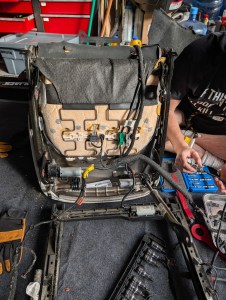
There is a lot going on in a Model 3 seat. Power adjust motors for at least four axes, occupancy sensor, seat heater, pretensioner, all wired into the body harness over proprietary connectors. The car will complain if it doesn’t see what it expects on the bus.
Plan: keep the rails and the slide motor, ditch the recline/height/lumbar mechanisms and the OEM frame, bolt the MPP seat on top.
o o o
FIRST PUMP FIRMWARE FIGHT
The fun one.
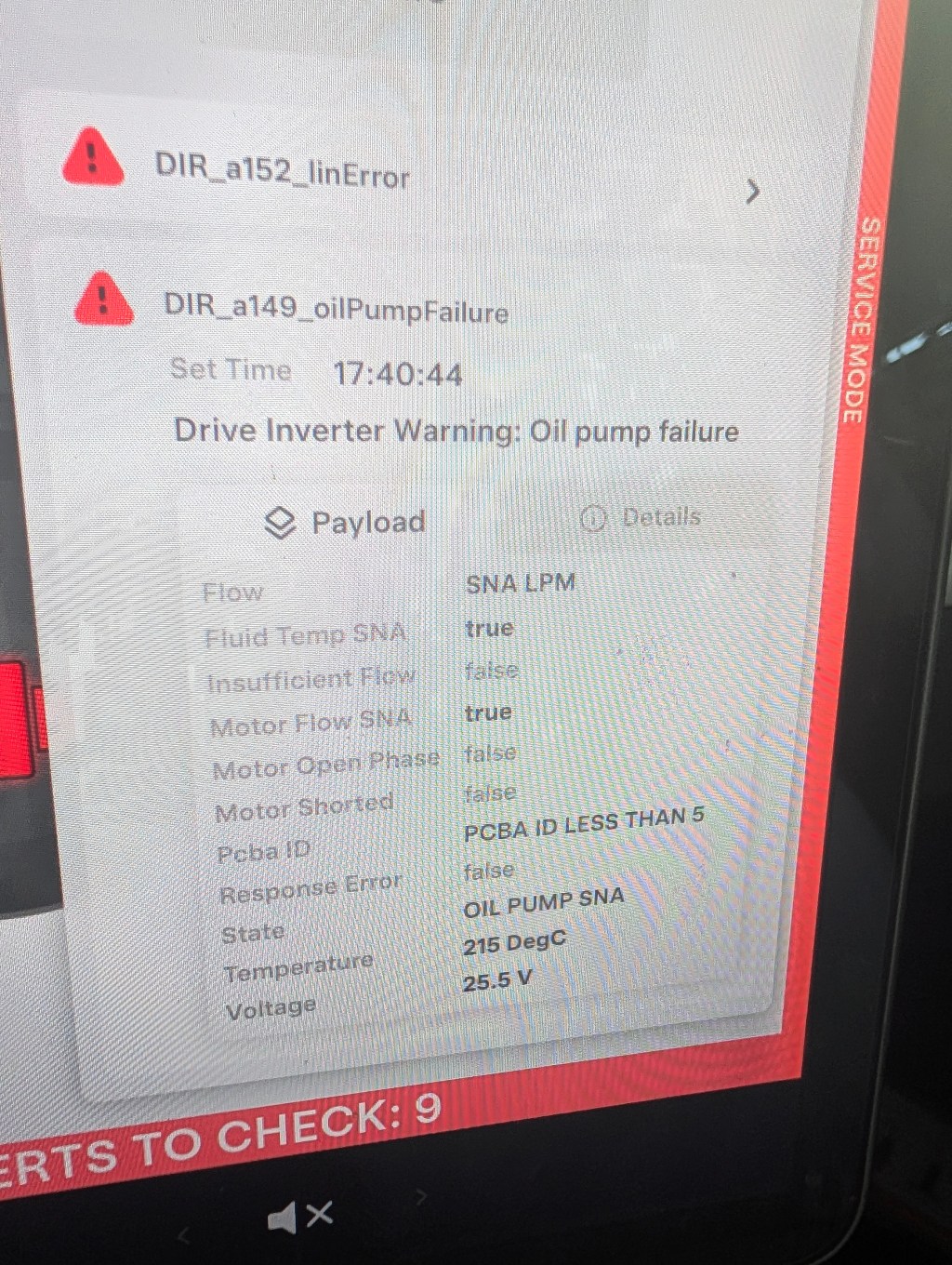
Post parts-swap, two related alerts came up:
DIR_a152_linError— LIN bus communication error from the drive inverterDIR_a149_oilPumpFailure— drive inverter oil pump failure
The payload told the story. State: OIL PUMP SNA. Flow: SNA LPM. And the line that actually mattered: Pcba ID: PCBA ID LESS THAN 5.
Translation: the replacement oil pump’s PCB revision is older than what the inverter firmware will accept. Tesla updated the hardware at some point and pinned the revision ID into a firmware compatibility check. The pump itself is fine — physically, electrically, talks LIN, all good. The inverter just doesn’t like its driver’s license.
First time we’ve hit a firmware-side compatibility wall on a salvage swap. Sorted it. Car’s happy, inverter’s talking to the pump, alert cleared.
Adding “PCBA ID rev gating” to the long list of things you don’t think about until a salvage Model 3 makes you think about it.
o o o
NEXT
Track test. Find what we missed.


Leave a Reply