
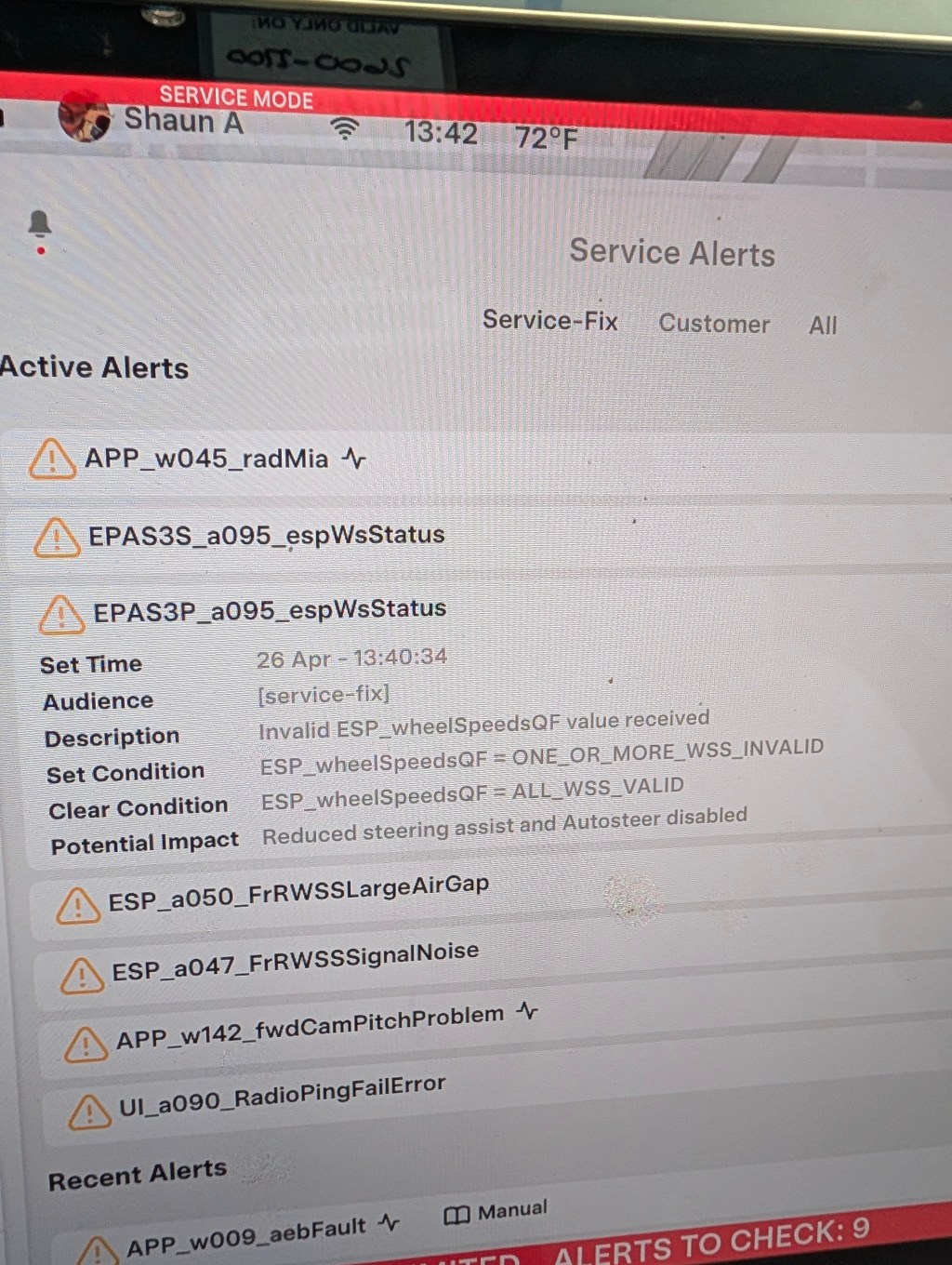
The car is back on the ground. New springs, new struts, fresh bushings everywhere, new rotors, new wheels. Two weeks of garage time. One weird sensor issue…finally resolved.
o o o
TO DRIFT OR NOT TO…
When the car starts up, the wheel speed sensors are checked. These sensors are critical to all of the vehicle dynamics from clever traction controls to basic stuff like Anti-lock brakes!
Our 1987 924s has none of these things. But it is close to half the power:weight ratio and it’s still pretty easy to lock up the front wheels. So driving the model 3 without ABS isn’t a very exciting prospect.
We made our way through a few inspections and changes – easy to just swap a good wheel speed sensor. No dice. Then we inspected the harness, thinking there might be an issue, but the error was about air gap vs no signal. So we rechecked install – there just aren’t any easy ways to misalign the sensor.
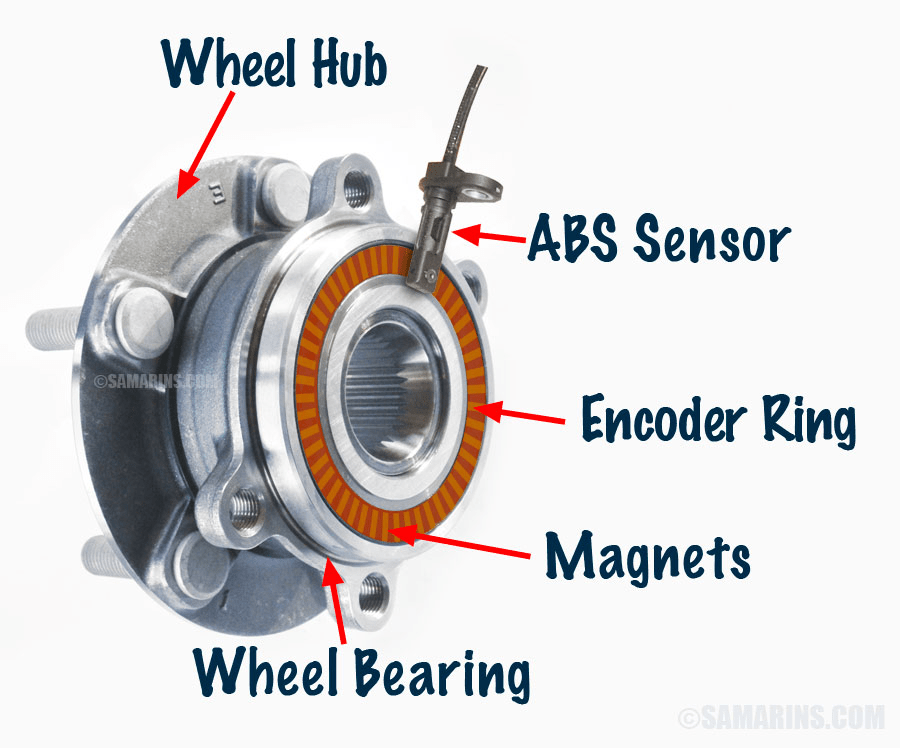
That’s when Claude suggested that statistically some of the aftermarket bearing hubs have a high failure rate on the magnetic ring that provides the signal to the wheel speed sensor (see below). So we ordered a new hub and tada…fixed.
o o o
Suspension: Set
Koni Sport struts + Eibach Pro-Kit springs. All four corners. We considered coilovers and walked away — more adjustment than we need, more money, more things to fiddle with. Which just means we’d fiddle more. The Koni dial gives us rebound damping we can tune; the Eibachs drop the car about an inch and stiffen up body roll. Lemons accounting: the struts are arguably safety (OEM dampers on a 4,000+ pound car at race pace is a real problem), the springs are probably performance and count against the $500 budget. We’ll explain ourselves at tech.
All bushings replaced. Front and rear, every link. The factory rubber on a 2019 salvage car of unknown crash history is not what you want holding the geometry together at the limit. Like the front end, there were plenty of sad cracked and worn rubber.
Drive unit mounts: visually fine. No tearing, no separation, no crunch. We’re considering injecting them with 3M windshield urethane — a stiffening trick that adds rigidity without ripping the mounts out and replacing them with solid pucks. Used in track Subaru and Mazda builds. May still do this.
Adjustable top arms front and rear. eBay sourced FUCAs up front and upper lateral link in the rear (the blue arms in the photos below). When you lower a car you add negative camber whether you want it or not. You can either accept it and burn through the inside edges of your tires, or install adjustable arms and dial it back. We picked the latter. Tire wear over a 24-hour endurance race adds up.
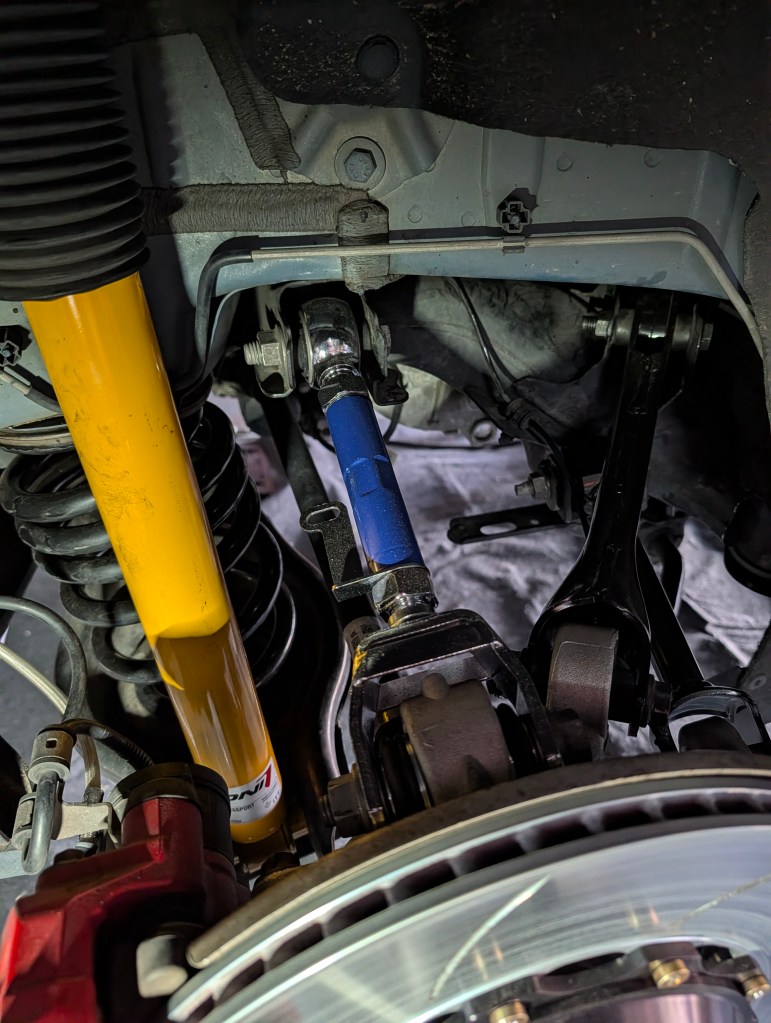
New springs, struts, bushings, brake rotor, brake lines.
o o o
Brakes: The Cooling Story
Rotors got replaced. Stock M3P Brembo calipers stay — they’re already pretty serious and they just clear the 18in wheels we prefer. Fresh full-thickness rotors all four corners.
Worth saying out loud: on an ICE car, brakes are about converting kinetic energy to heat and dumping that heat into the air. On an EV, regen does most of that work — but regen converts kinetic energy into battery heat and drivetrain coolant load. The battery already has a thermal ceiling on track. So when you dial regen back to protect the pack and the cooling system, you’re shifting that energy demand back onto the mechanical brakes. Especially the front.
Which is to say: the brake rotors aren’t just a stopping decision on this car. They’re part of the thermal management story. Fresh rotors also mean an opportunity for more cooling, so these do more than the stock rotors with some additional tricks to push more air from the center vs stock and they’re slotted to allow some additional cooling.
o o o
Wheels: The Rotor Problem
The Performance car comes on 20″ wheels. They’re heavy and require thin sidewall tire. Thin sidewalls bend easily — potholes, curbs, track curbs especially. A bent wheel at race pace is not a fun afternoon. So we wanted smaller 18s. More sidewall, less unsprung mass, similar rolling diameter.
The hitch: the stock Tesla 18″ Aero wheel does not clear the OEM brake rotors. Two ways forward — shave the rotors to fit the Aeros, or buy aftermarket 18″ wheels with the clearance built in. Shaving rotors is doable. It’s also reducing thermal mass on a heavy EV that’s already asking a lot of the front brakes (see above). Given this is safety budget item, didn’t seem like place to save. So OEM wheels it is.
9.5″ wide, 245-section tires for now. Falken RT615K+ — the Lemons-favorite endurance tire. We’ll A/B test 245 vs 265 on track to see what the range/grip tradeoff actually looks like. Wider gives more contact patch (better cornering, better stopping); wider also costs you rolling resistance and a hair of aero (range, stint length). On an EV that math matters more than on a gas car.
o o o
Budget Calculus
Brake rotors and wheels are the biggest line items so far. Almost all of this lives outside the $500 Lemons budget — either as safety (rotors, struts, kept-stock-thickness rotors instead of shaved ones) or as honest performance choices (lowering springs, adjustable camber arms, 9.5″ rim width over 8.5″). We’re not going to pretend the camber arms are safety equipment.
We’ll bring receipts and explanations.
o o o
Next
Few more checks and it’s time to get to track and see whats what.

