
The Gauntlet
Reviving a salvage vehicle in California is not one inspection. It’s a multi-visit odyssey across three different agencies, each with their own paperwork, appointments, and opinions about whether your car deserves to exist on public roads again. Here’s what it took:
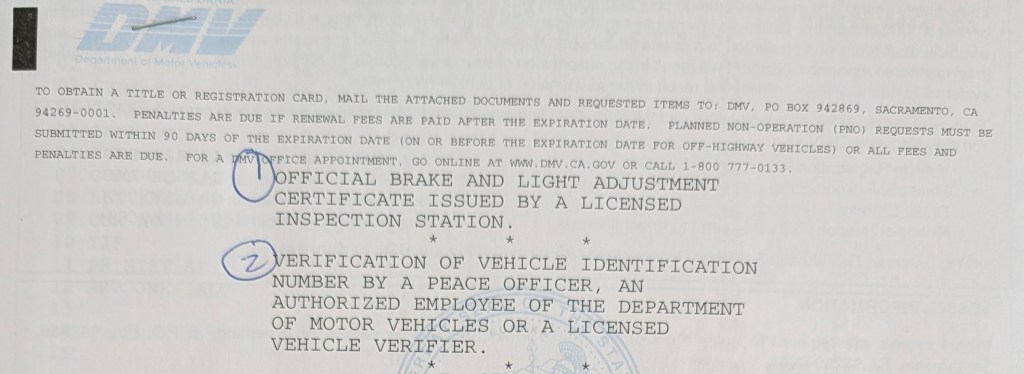
1. DMV Visit 1 — pay all fees, get a CHP referral, pick up a Temporary Operating Permit so you can legally drive the car to the rest of the inspections.
2. Pep Boys — VSSI + Brake & Light — a Vehicle Safety Systems Inspection and Brake & Light Adjustment Certificate. They check that all the safety systems work as intended. Lights, brakes, steering, suspension. The car passed.
3. CHP Inspection — the California Highway Patrol verifies the VIN, checks your paperwork and receipts, and confirms the vehicle matches what you say it is. They want to make sure your salvage rebuild isn’t hiding stolen parts. Bring photos, receipts, everything.
4. DMV Visit 2 — bring all the certificates back. If everything checks out, they issue a Revived Salvage title and new plates.
It checks out. We have plates.
o o o
What WE DID
To pass all of the inspections, the car needed to be mechanically sound and have all its lights, glass, and safety equipment working. Here’s what we installed:
1. Windshield — $600. The original was cracked from the collision. Can’t pass any inspection without it, can’t safely drive without it. What’s wild is the range of quotes from $600 to do in our garage to $1400!
2. Passenger headlight — $148.15. OEM LED reflector unit from eBay. Required for the Brake & Light certificate. Safety budget again for Lemons, though some races don’t have night time hours, so not always required.
3. Front lower control arms (4pc set) — $157.19. The originals were damaged in the front-end hit. OEM-spec replacements. You don’t drive a car with compromised suspension geometry. Safety.
4. Inner and outer tie rods — $99.00. The passenger-side tie rod was bent in the collision — this was the most visible mechanical damage from the crash. OEM-spec TRQ replacements, not performance parts. Restoring safe steering. Safety.
Total mounted: $991.18. All Lemons safety vs go-fast budget.
o o o
The Lemons Budget
24 Hours of Lemons has a $500 budget cap on the car. But safety items are exempt — you don’t penalize a team for making their car safe to race. And every single mounted part on this build so far was replacing crash-damaged components with OEM-spec replacements. Not upgrades. Not performance parts. Just putting the car back to the condition it should have been in before someone drove it into something.
A windshield, a headlight, control arms, tie rods — all of it necessary to pass a state safety inspection. All of it OEM-spec. We’re claiming the full $991.18 as Safety-exempt.
Lemons budget spent so far: $0.
o o o
One Step Left
The car is registered. It’s insured. It drives. But there’s one more thing before it’s fully back in the Tesla ecosystem: the High Voltage Inspection and Supercharger test at a Tesla Service Center.
When a Tesla has been totaled, Tesla disables Supercharging access on the vehicle. To get it reinstated, they require a safety inspection of the high-voltage battery system at one of their service centers. They check the pack, the contactors, the cooling system, and then run a supervised Supercharger test to confirm the car charges safely at high power. It’s a required step — you don’t want a compromised battery pack pulling 250kW from a public charger.
For us, this is the final gate. Once the car can Supercharge, the charging logistics for race weekends open up completely. We’ll know the results in the next few days.
 Outrun Carbon